Introduction
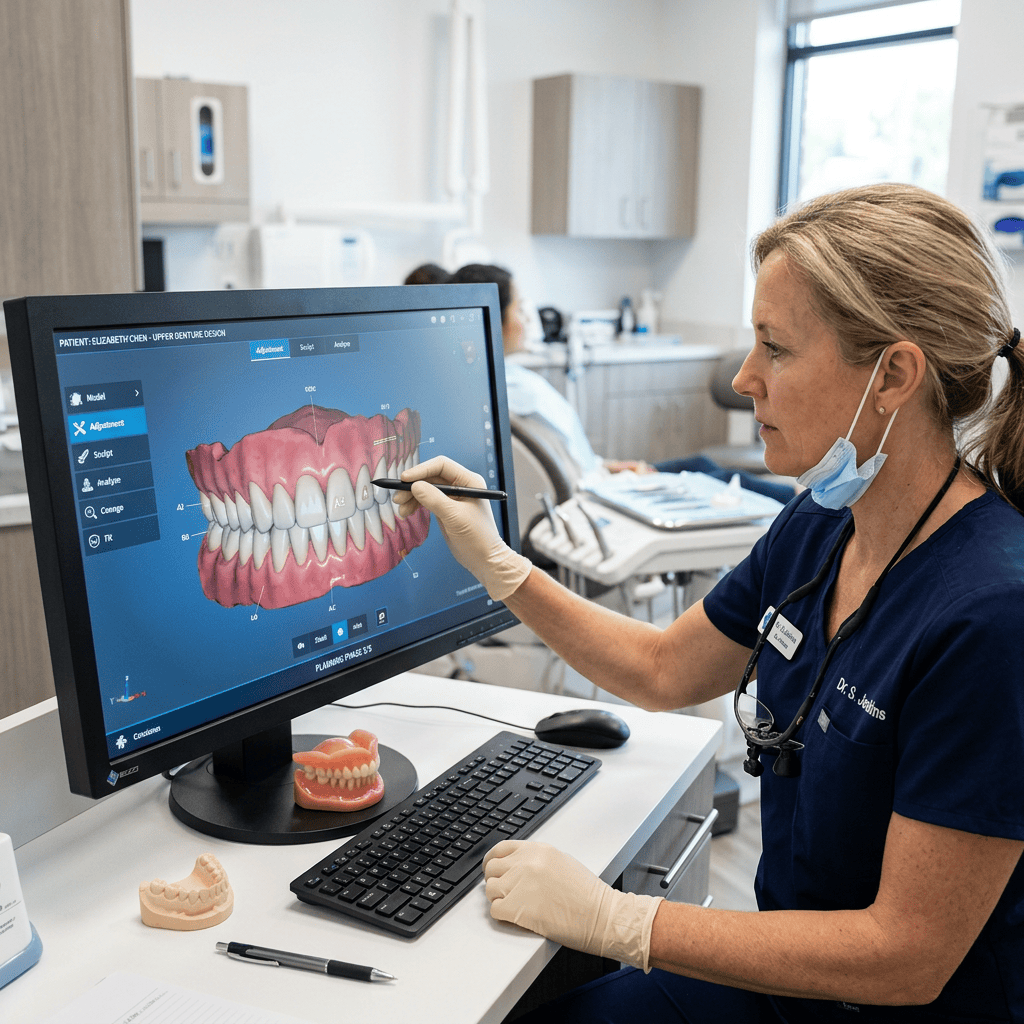
Digital dentistry is changing the way dental practices approach denture treatment. By combining digital impressions or scans, CAD (computer-aided design), CAM (computer-aided manufacturing), and digital records, practices can move from a largely manual denture workflow towards a more streamlined, reproducible and traceable process. For dental practices, the real opportunity is not simply to replace analogue techniques with digital ones. It is to use digital dentures as a quality improvement tool – improving flow, reducing variation, measuring performance and creating more predictable processes for both patients and the dental team.
Conventional dentures can involve several appointments, physical impressions, casts, wax rims, tooth arrangement, try-in stages and laboratory procedures. Each stage introduces opportunities for variation or error. Digital denture workflows can reduce some of these steps and allow information to move electronically between the practice and laboratory. Published clinical workflows have demonstrated that digital approaches can facilitate fewer and shorter appointments, while more recent research has described workflows involving only a small number of clinical and laboratory stages (Maragliano‐Muniz and Kukucka, 2021). This matters from a practice-management perspective. A workflow with fewer handoffs and fewer physical stages can be easier to standardise, audit and improve.
Improving efficiency and reducing wasted time
One of the most obvious advantages of digital dentures is workflow efficiency. A systematic review published in 2025 found that digital and hybrid complete-denture workflows generally reduced both clinical and laboratory time compared with conventional workflows. The review reported laboratory time reductions of several hours for hybrid and fully digital workflows, with evidence also suggesting improved cost-effectiveness (Grande et al., 2025). For a practice, the benefits can extend beyond the number of appointments. Digital workflows can help:
- Reduce repeated laboratory stages such as denture try-ins.
- Reduce the amount of physical paperwork and models stored.
- Simplify communication with the dental laboratory.
- Make laboratory prescriptions easier to understand.
- Reduce chair time associated with certain conventional stages.
The result is a workflow in which clinical time can be focused on diagnosis, treatment planning and patient care rather than unnecessary repetition.
Standardisation
Quality improvement is fundamentally about making processes more reliable. In a conventional workflow, the outcome can depend heavily on individual technique: how an impression is taken, how a record base is produced, how information is transferred to the laboratory and how the denture is manually processed. Digital workflows introduce opportunities to standardise these processes. For example, a practice can develop a defined digital-denture protocol specifying:
Assessment → data capture (scanning) → jaw relationship (scanning) → digital design → clinical verification → manufacture → fit.
Each stage can have defined criteria for completion. This creates an opportunity to introduce standard operating procedures (SOPs) and checklists, making the workflow less dependent on individual clinicians or technicians. From a QI perspective, this is important because standardisation reduces unwanted variation
Better traceability and record keeping
A significant advantage of digital dentistry is the creation of a digital record of the prosthesis. Digital files can include scans, photographs, jaw relationships, denture designs and manufacturing information. This can be particularly valuable when a patient loses or damages a denture as rather than starting the process again from the beginning, an existing digital design can provide a reference for reproducing the prosthesis, depending on the system, records available and clinical circumstances.
Improving communication between the practice and laboratory
Dentures are a team effort involving the dentist, dental nurse, technician and patient. Digital workflows can reduce some of the communication gaps that occur when information is transferred through physical models, handwritten prescriptions and multiple manual stages. A shared digital workflow can make it easier for the laboratory to access relevant information and for the clinician to review proposed designs before manufacture, reducing uncertainty around designs.
Measuring Quality and PDSA cycles
Digital dentures make it easier to introduce measurable quality indicators. A practice could monitor factors such as:
- Number of denture appointments
- Average chair time
- Laboratory turnaround time
- Number of adjustment appointments
- Remakes within 12 months
- Patient satisfaction
- Denture-related complaints
- Cost per completed case
- Number of digital cases successfully completed
These measures can then be reviewed using a Plan–Do–Study–Act (PDSA) approach. For example:
Plan: Introduce a standard digital denture protocol.
Do: Use the protocol for 20 consecutive patients.
Study: Compare appointment numbers, adjustment visits, remakes (for example) with the previous 20 conventional cases.
Act: Modify the workflow based on the findings and repeat the cycle.
This transforms digital dentistry from simply being “new technology” into a structured improvement tool that can be tailored to the needs of the dentist, and their practice and patients.
Improving consistency and accuracy
Digital dentures can also support consistency in design and manufacturing. A systematic review of digitally fabricated complete dentures found that most included studies reported clinically acceptable occlusal trueness and adaptation, with digital dentures demonstrating similar or better adaptation than conventional dentures in many of the evaluated studies. However, digital does not automatically mean perfect. Accuracy depends on the scanning technique, CAD/CAM system, manufacturing method and clinical situation. In particular, capturing the functional morphology of mobile soft tissues in completely edentulous patients remains challenging (El Osta et al., 2025). This is an important quality improvement lesson: technology should support clinical judgement, not replace it. Practices should therefore determine which cases are appropriate for a digital workflow and when conventional or hybrid techniques remain preferable.
Enhancing the patient experience
Quality improvement should ultimately translate into better patient care. Digital workflows can potentially reduce the number of appointments and shorten some clinical procedures. Research has identified reduced workflow times and improvements in patient comfort as potential benefits of digital approaches (Wadia, 2025). This can be particularly valuable for older patients, patients with mobility difficulties and those who find conventional impression procedures uncomfortable. A shorter, more predictable pathway can improve the overall patient experience – but practices should measure this rather than simply assume it.
A simple post-treatment questionnaire could ask patients to rate:
- Comfort during appointments
- Ease of understanding the treatment
- Number of appointments
- Confidence in the final denture
- Overall satisfaction
- Willingness to recommend the service
Conclusion
Digital dentures can offer dental practices much more than a modern alternative to conventional dentures. When implemented thoughtfully, they can become part of a wider quality-improvement strategy.
By reducing unnecessary steps, standardising processes, improving laboratory communication, creating traceable digital records and enabling meaningful performance measurement, digital workflows can help practices build a denture service that is more efficient, reproducible and patient-centred.
The key is not simply to ask, ”Can we make dentures digitally?”. The more valuable question is: “How can digital dentistry help us build a better, safer and more measurable denture pathway?”.
That shift – from adopting technology to improving the system of care – is where the real quality-improvement opportunity lies.
References
El Osta, N., Bessadet, M., Drancourt, N. and Batisse, C. (2025). Time efficiency and cost of fabricating removable complete dentures using digital, hybrid, and conventional workflows: A systematic review. The Journal of prosthetic dentistry, 133(5), pp.1194-1208.
Grande, F., Pavone, L., Molinelli, F., Mussano, F., Srinivasan, M. and Catapano, S. (2025). CAD-CAM complete digital dentures: An improved clinical and laboratory workflow. The Journal of Prosthetic Dentistry, 133(6), pp.1430–1435.
Maragliano‐Muniz, P. and Kukucka, E.D. (2021). Incorporating Digital Dentures into Clinical Practice: Flexible Workflows and Improved Clinical Outcomes. Journal of Prosthodontics, 30(2), pp.125-132.
Wadia, R. (2025). Digital scans for complete dentures. British Dental Journal, [online] 238(8), pp.644–644.


Leave a Reply