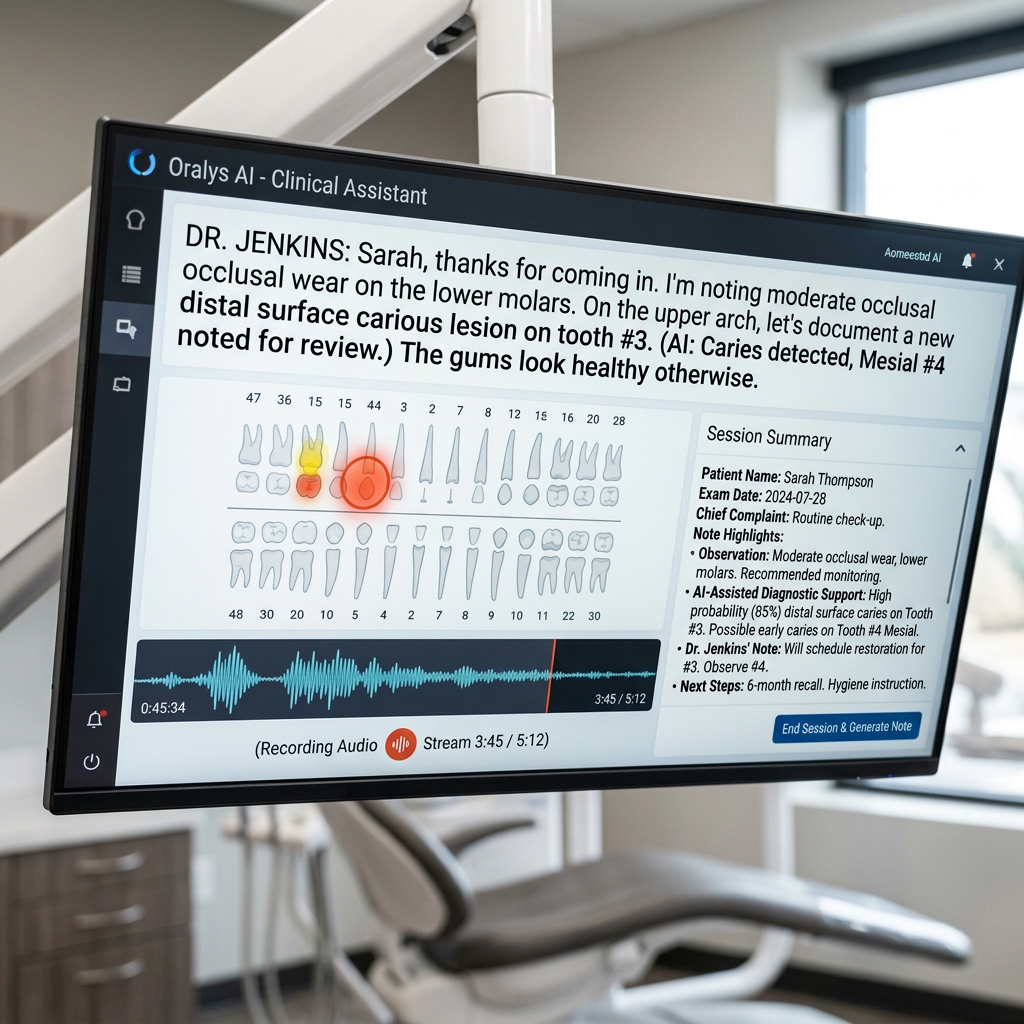
Artificial intelligence (AI) is becoming an increasingly important part of modern healthcare, and dentistry is no exception. From digital imaging and treatment planning to patient communication and administrative support, AI has the potential to transform the way dental professionals work. One particularly interesting development is the use of AI-powered programmes to assist with clinical notetaking during appointments, known as Ambient Voice Technology (AVT).
Traditionally, dental clinicians have been responsible for documenting every consultation, examination, diagnosis, and treatment carried out during a patient appointment. Although accurate clinical records are essential for patient safety, continuity of care and medico-legal protection, writing detailed notes can be time-consuming and can distract from the interaction between the clinician and patient. AI-powered note-taking programmes offer a potential solution by listening to clinical conversations and generating structured clinical notes automatically.
However, while this technology offers exciting opportunities, it also raises important questions regarding accuracy, confidentiality, and professional responsibility. We have discussed advice on assessing AI use in practice in a previous post.
How does AI note-taking work in a dental practice?
AI-powered clinical writing software generally works by using speech recognition and language processing to interpret conversations between the dentist and patient. During an appointment, the software can listen to the consultation, identify relevant clinical information, and organise it into a structured clinical record.
For example, during a routine examination, a dentist may discuss the patient’s medical history, symptoms, oral hygiene habits, clinical findings, and proposed treatment. Rather than manually typing or writing everything down, an AI programme can generate a draft clinical note based on the conversation.
Some programmes can also organise information into familiar clinical headings, such as:
The dentist can then review, amend, and approve the generated notes before adding them to the patient’s clinical record. This is particularly appealing in a busy dental practice, where clinicians often have limited time between appointments to complete their notes.
- Presenting complaint and history of presenting complaint.
- Medical and dental history.
- Extraoral and intraoral examination findings.
- Diagnosis and treatment options.
- Risks, benefits, and alternatives discussed.
- Patient consent and agreed treatment plan.
- Postoperative instructions and follow-up arrangements.
The advantages of AI-assisted clinical notetaking
1. Improved time efficiency
One of the most significant benefits of AI notetaking is the potential to save time. Dental appointments are often tightly scheduled, and completing detailed clinical notes can result in dentists spending additional time after appointments catching up with documentation. AI programmes may reduce this administrative burden by producing an initial draft of the clinical record automatically. This could allow dentists to spend less time typing and more time concentrating on clinical responsibilities, patient care and treatment planning. In the longer term, improved efficiency may also help reduce the amount of administrative work dentists take home at the end of the working day, potentially contributing to a better work-life balance.
2. Improved patient communication and rapport
A further advantage is the opportunity to maintain better eye contact and engagement with patients. When dentists are typing notes throughout an appointment, their attention can become divided between the computer screen and the patient. This may affect communication and make consultations feel less personal. With AI-assisted notes, dentists may be able to focus more fully on listening to patients, explaining treatment options and answering questions. This could help create a more relaxed clinical environment and improve the patient experience. Patients may feel that their concerns are being heard rather than feeling that the dentist is concentrating primarily on the computer.
3. More structured and consistent clinical records
AI programmes can potentially improve the organisation and consistency of clinical documentation. By using standardised templates and structured headings, these systems may help dentists produce more comprehensive records and reduce the likelihood of forgetting important sections of a consultation. For example, a well-designed system could prompt the clinician to consider documenting consent, relevant medical history, treatment alternatives, and postoperative advice. This may be particularly useful in busy practices where multiple clinicians contribute to a patient’s care.
The disadvantages and limitations of AI notetaking
Despite its potential benefits, AI-assisted clinical documentation is not without limitations. It is important to recognise that AI is an assistive tool rather than a replacement for professional clinical judgement.
1. Accuracy and interpretation
Perhaps the greatest concern is whether AI can accurately interpret clinical conversations. Dentistry involves complex terminology, abbreviations, and specific descriptions of clinical findings. For example, a discussion about a tooth requiring endodontic treatment, the presence of a periapical radiolucency or a periodontal pocket measurement may not always be interpreted correctly by general speech-recognition software. AI may also misunderstand conversations where the dentist and patient speak simultaneously, where there is background noise or where patients use unfamiliar terminology. Another potential issue is that AI may produce information that sounds clinically appropriate but was never actually discussed. This is particularly concerning if incorrect information is added to a patient’s permanent clinical record. For this reason, every AI-generated note must be carefully checked and approved by the treating dentist.
2. Patient confidentiality and data protection
Patient confidentiality is a fundamental responsibility within healthcare, and the introduction of AI notetaking creates additional considerations. These programmes may process sensitive personal and medical information, including details about medical conditions, medication, dental history, and treatment discussions. Dentists must therefore consider where the information is stored, who has access to it and whether it is being processed securely. In the UK, practices must ensure that their use of AI complies with relevant data protection legislation, including UK GDPR and the Data Protection Act 2018. Patients should also be informed when AI technology is being used to assist with clinical documentation, with appropriate transparency and consent arrangements in place. Practices should assess their data protection responsibilities before introducing such systems.
3. Over-reliance on technology
Another concern is that dentists could become overly dependent on AI-generated notes. Clinical documentation is not simply a transcription exercise. It requires the dentist to identify relevant findings, interpret information and record appropriate clinical decisions. If clinicians begin relying too heavily on automatically generated notes, there is a risk that key details may be overlooked or that records may become less individualised. For example, an AI programme may generate a comprehensive description of a consultation but fail to capture the clinical significance of a particular finding. The dentist must therefore remain responsible for the content and quality of the final record.
4. Financial costs and accessibility
Introducing AI technology also comes with financial considerations. Some programmes require monthly subscriptions, additional hardware, or integration with existing practice management software. There may also be staff training costs and time required to introduce new systems into the practice. For smaller dental practices, these expenses may be difficult to justify, particularly if the software does not integrate effectively with their existing clinical systems. There is also a learning curve associated with adopting new technology, and some clinicians may initially find it more time-consuming to review AI-generated notes than to write them independently.
How could AI notetaking improve in the future?
The future of AI in dentistry offers exciting opportunities to improve clinical documentation and patient care. As technology develops, AI programmes could become more integrated, accurate and personalised. Future developments could include:
1) Integration with practice management software: Automatically transferring clinical findings, treatment plans, and medical history updates into the correct sections of patient records, reducing repetitive administrative work.
2) Improved dental terminology recognition: Developing dental-specific AI systems that better understand tooth notation, periodontal measurements, and clinical terminology, improving the accuracy of notes.
3) Integration of clinical information: Combining verbal consultations with radiographs, intraoral photographs, periodontal charting, and previous patient records to create more comprehensive clinical documentation.
4) Personalised documentation: Allowing AI to adapt to individual dentists’ preferred note-taking styles while identifying missing information and prompting clinicians to complete relevant sections.
5) Wider patient care support: Using information from consultations to help generate referral letters, postoperative instructions, and follow-up communications, reducing administrative workload.
Conclusion: An opportunity to enhance dentistry, not replace dentists
AI-powered notetaking has the potential to become a valuable tool in modern dental practice. By reducing administrative workloads, improving the structure of clinical records, and allowing dentists to focus more closely on their patients, it could make a meaningful difference to the daily working environment. However, its introduction must be approached carefully. Concerns surrounding accuracy, patient confidentiality, data protection and over-reliance on technology cannot be overlooked. AI-generated documentation should always be reviewed by the treating clinician, who remains responsible for ensuring that the final record is accurate and complete.
Further Reading
News and Reports
NHS England guidance on AI notetaking
Published Papers
Nassani, Leonardo M., Gustavo Vicentis Oliveira Fernandes, Nicole L. Buchanan, Zeinab Mohamed, Romana Muller, Sherrie Costello, and Teresa Kania. (2026). “Perceptions of Artificial Intelligence-Based Documentation in Dental Hygiene Clinical Education and Patient-Provider Connection: A Pilot Study.” Journal of Dental Hygiene 100 (4): 47–57.
O’Kane, Ruairí, Daniel Stonehouse-Smith, Melody Shirazi, Rachel Hutchinson, Jadbinder Seehra, and Martyn T Cobourne. (2026). “For the Record: A Narrative Review of Ambient Voice Technology in Clinical Documentation for Dentistry and Wider Healthcare.” British Dental Journal 241 (6): 385–93. https://doi.org/10.1038/s41415-026-9951-9.


Leave a Reply