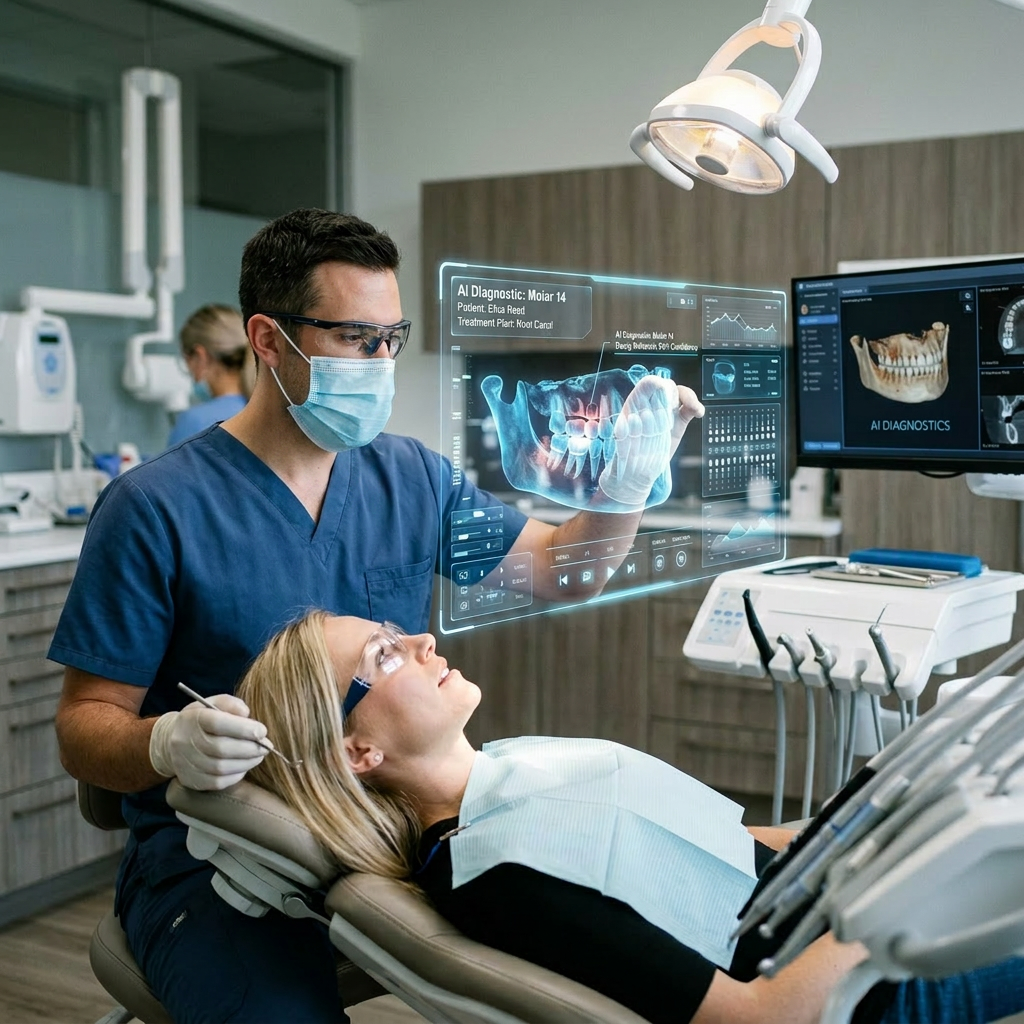
Dentists walk a difficult line between innovation and maintenance of quality. Artificial Intelligence (AI) applications have flooded into dentistry in the last few years. From isolated products, most major dental services retailers are now integrating AI into their products. Some have developed applications from scratch, while others have bought rights from others, or in some cases, purchased entire AI start-ups to incorporate their technology into existing products.
AI has made major inroads into back office products, including advertising, front desk functions such as answering routine calls, booking appointments and sending reminders, and billing.
In clinical applications, many imaging companies now offer diagnostic AI products helping interpretation, all the way up to treatment planning. These products can improve accuracy and streamline work, but they also carry risks. Clinicians remain responsible for treatment, as Dental Protection make clear in their recent AI guidance.
With no sign of the AI rush slowing in oral health care, it is essential that practices and individual clinicians are able to get to grips with the use of AI. For new dentists moving from dental school to clinical practice, being prepared is important. Dentists from Thailand argue that dental schools need to act fast to make curriculum changes that will allow this to happen.
Thanaphum Osathanon and colleagues argue that ignoring AI is a non-starter. They argue that dental students need to be taught to:
- Understand the principles of AI
- Apply and develop AI applications
- Use critical thinking in AI application
- Know how to apply appropriate ethical standards, including informed consent.
These make sense. It seems very unlikely that most dental professionals would maintain the competence – and confidence – to develop or modify AI applications, but having a grasp of how they are constructed and applied will help to increase confidence, and support reflective judgement on the outputs of AI systems.
They conclude that:
‘Curriculum mapping should integrate AI education vertically across preclinical, clinical, and final years while ensuring horizontal alignment with existing subjects and competencies. Early stages introduce AI fundamentals alongside basic sciences and ethics, progressing to clinical applications in diagnostic and treatment planning, AI-enabled virtual reality systems for dental education, and culminating in advanced ethical and professional considerations through projects and electives.’
This is a huge call for already crowded dental curriculums and busy teaching staff. Given the likely ubiquity of AI in future dental care, it is difficult to see any alternative if we want students to be able to rapidly adapt to their clinical environment when they graduate.
There is a clear role for national regulatory organisations to support this development to avoid each University having to reinvent the AI wheel. The work will be enormous, but if we want to maintain the quality of dental services and even enhance it, understanding Dental AI, and its limitations, will be essential.
Reference:
T. Osathanon, A. Vacharaksa, F. Schwendicke, LP. Samaranayake. (2026) Preparing the AI-ready dentist: a call for a competency framework in dental education. Int Dent J, 76 (2), p. 109450, 10.1016/j.identj.2026.109450


Leave a Reply