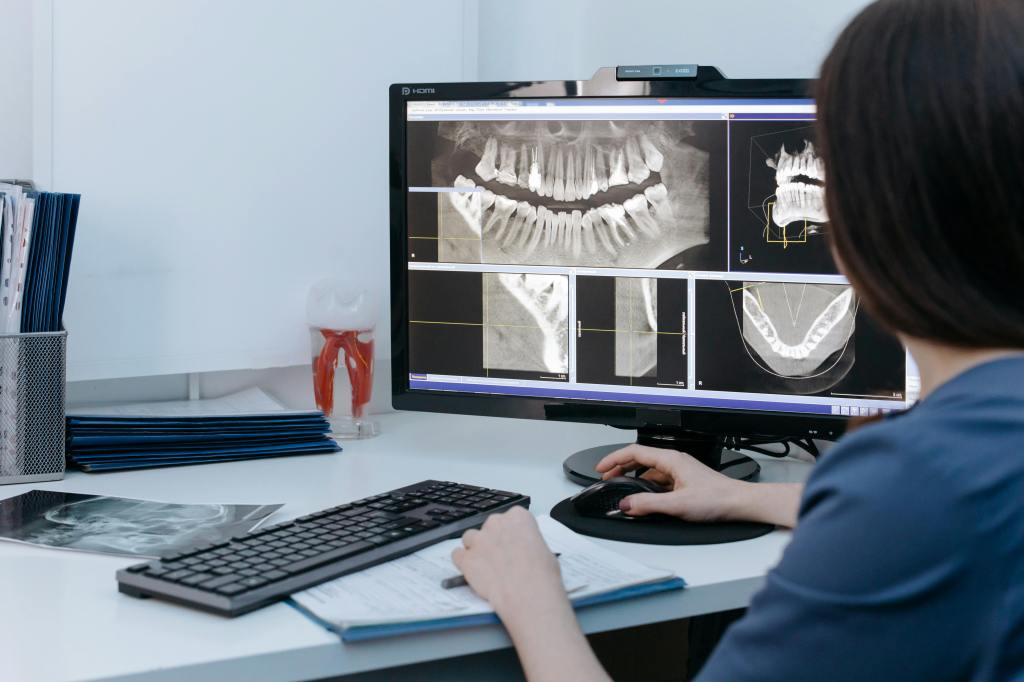
In recent years, Dentistry has started to embrace the Artificial Intelligence (AI) technology now available, and several programmes have been created to support clinical procedures. This is one of a range of uses of AI in dentistry.
One example of a clinical application is using Artificial Intelligence to examine radiographs, for which several programmes now exist. The benefits of using this kind of technology are obvious: less human error from reading radiographs wrongly, quicker analysis, and increased patient trust and acceptance for proposed treatment.
Schwendicke et al (2020) explain that using AI in medicine or dentistry can streamline routine work and humanise care by giving doctors or dentists more time with their patients. However, as with all technology, there are limitations.
The latest figures show that radiograph reading AI has a success rate of identifying dental caries over 91% of the time. It was also observed that it was accurate in detecting maxillary sinusitis and bone loss due to periodontal disease. A systematic review conducted by Alam et al in early 2024 showed that AI reading technology showed a superior performance in detecting dental caries on radiographs than a cross section of dentists. Increased accuracy has the potential to improve patient safety, with less dental disease undiagnosed from radiographs due to human error. Other reviews report varying accuracy rates and value for different procedures, such as in paediatric dentistry, designing crowns, planning implants, and assessing oral lesions and periodontal bone loss.
In practice, dentists are likely to incorporate information from AI systems into their practice, with AI contributing to their assessment. As with any technology, it should be integrated into normal practice and used as an enhancement, not a replacement for human thinking. Dental diagnosis incorporates many other aspects than just radiographs: medical and dental history, clinical exam of soft tissues, teeth, gingivae and reported symptoms. Even with improved AI, dentists need to be at the core of dental diagnosis.
Schwendicke explains that there are a few reasons why AI technology has not yet been fully adopted by the dental community. The first being that dental data is often protected due to it being personal information of patients. AI learns from having datasets available to build its intelligence. If there is limited available data due to security, it will take much longer for the AI system to gain predictability and efficiency. Another reason is that it is not often possible to define a ‘gold standard’ due to difference in expert opinion. Schwendicke explains that there is no agreement on how many ‘experts’ it takes to define a data point, often leading to conflicting results.
The future of AI reading for dental radiographs looks bright, with many improvements planned to develop the current system to improve reliability. Now, many of the current programmes have a sample size of only a few thousand, whereas in the future it is hoped that several million samples will be included in the dataset. Currently, the system works with association modelling, with a planned switch to predictive modelling which should increase predictability. Generative models also offer potential benefits.
The human factor will be key in the adoption of dental applications of AI. Dentists have to feel that they are gaining from the use of AI, that their patients are not at risk, and that any additional costs are worth the benefits. Understanding how dentists come to use AI in practice, what influences their views, and how they incorporate it into their work will be essential.
In conclusion, artificial intelligence in dental radiography is starting to leak into the market, with many dentists embracing the technology. The current programmes are fairly reliable but should be introduced into practice in conjunction with other aspects of dental diagnosis such as clinical exam and patient history including medications and symptoms. Using AI in radiograph reading can improve patient safety, prevent misdiagnosis and increase patient trust. The field is moving very quickly, and as the programmes increase in predictability, and are incorporated into imaging review systems, the use of AI in dental radiography is likely to come to be widely accepted by dentists.
Photo by Cottonbro Studio at pexels.com
 Dental Quality Improvement
Leave a comment